
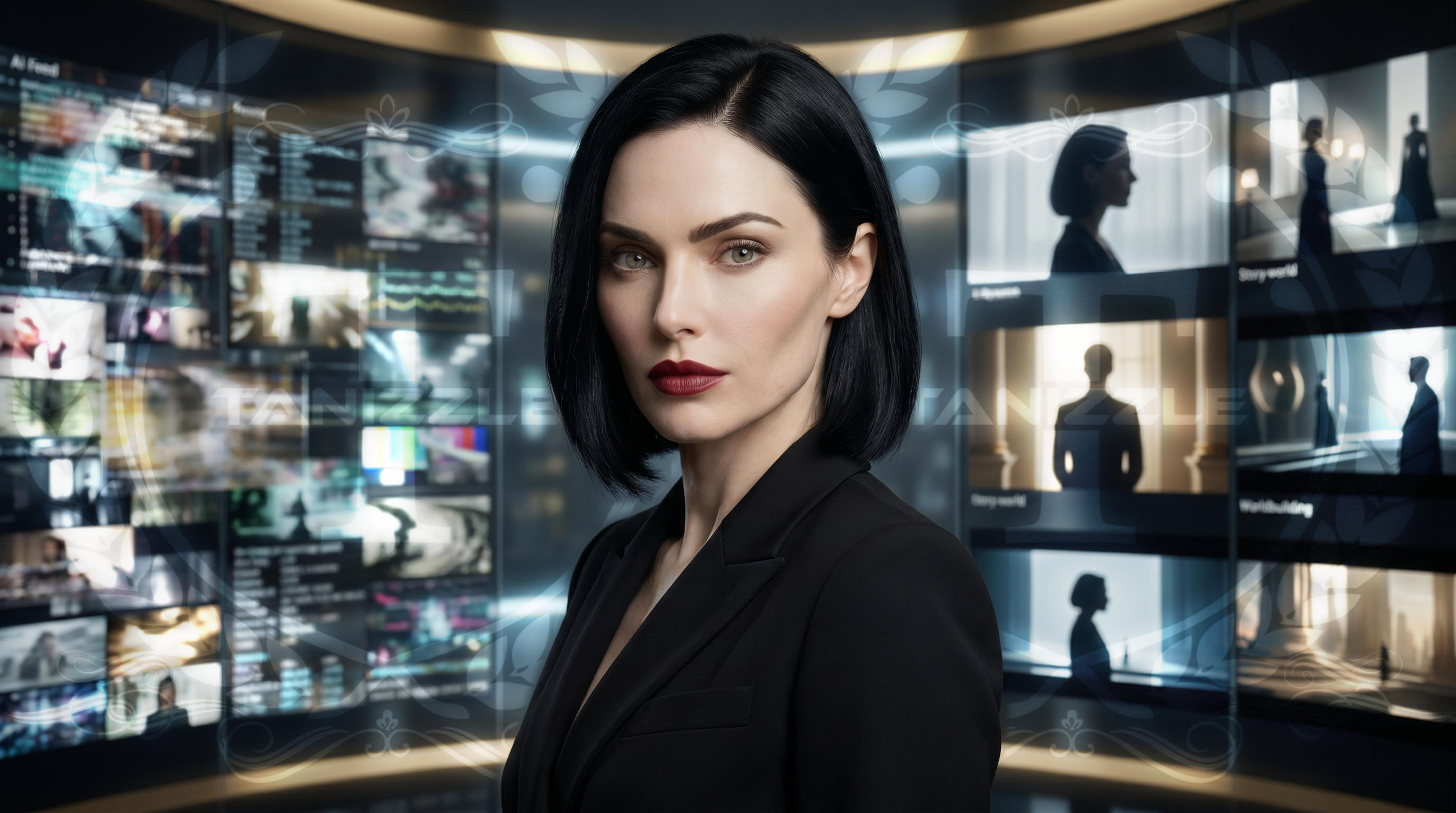
AI-native entertainment is pushing the creator economy beyond slop into worlds, formats, characters, and scalable original digital storytelling.
Why The Next Creator Era Belongs To Worlds, Not Slop
AI-native entertainment is the next phase of the creator economy: content built with AI woven into the production foundation, not awkwardly taped on at the end like a gimmick. It is not just "use AI for a thumbnail" or "prompt a random clip and upload it." It is a broader shift where creators, studios, and entertainment companies treat AI as part of how worlds, formats, characters, production systems, and repeatable content pipelines are designed from the start.
YouTube's own 2026 priorities say the line between creativity and technology is blurring, and frame creators as the new stars and studios of entertainment rather than some side category of internet noise. The platform also says more than 1 million channels used its AI creation tools daily in December, while continuing to push creator monetisation, shopping, and brand partnerships. That means AI-assisted creation is not sitting in the weird corner anymore. It is moving into the centre of the creator economy.
That's why Tanizzle is calling this now: AI-native entertainment is coming for the creator economy, and the people who still think the future is just low-effort prompt sludge (aka AI Slop) are staring at the wrong part of the story. Slop was never the destination. Slop was the cheap early symptom of a more important transition. The creators who win the next phase will not just generate content. They will build systems, formats, characters, visual languages, and story worlds that AI can help scale without flattening the soul out of the work.
What AI-Native Entertainment Actually Is
AI-native entertainment is storytelling, media, or branded content built around AI-native or hybrid workflows from concept through delivery. One of the clearest public descriptions of this model comes from Secret Level, which describes itself as an AI-native entertainment studio creating films, series, music projects, and brand worlds by blending creative talent with AI-native and hybrid production workflows. It also says it builds story worlds that can live across films, series, music, brands, and experiences, which is the key part.
That is the distinction. AI-native entertainment is not "an AI video." It is not a disconnected one-off where a robot makes a weird cat do backflips and the internet claps because the software remembered how gravity works badly. It is a mode of production. It is narrative logic plus visual consistency plus tone plus recurring identity plus distribution plus repeatability. In other words, it starts looking suspiciously like entertainment, which is exactly why some people are going to underestimate it until it is too late.
YouTube's own creator direction supports this. In 2025 it introduced a wave of AI creation features, including Veo 3 Fast for Shorts, motion transfer, stylisation, object insertion, AI-assisted editing, and music tools, all aimed at making creation more playful and scalable for creators. This is not the behaviour of a platform that thinks AI in media is a side hobby. This is infrastructure being laid in public.
The Creator Economy Is Already Turning Into Studio Infrastructure
The creator economy is no longer just people posting from bedrooms and hoping the algorithm smiles at them. That romantic little story is outdated. YouTube's 2026 letter says creators are reinventing entertainment, building the media companies of the future, and green-lighting themselves. It points to creators expanding into more ambitious production and treats YouTube as a platform where creators can grow businesses, not just channels.
The scale of that shift is not subtle. YouTube says it has paid over $100 billion to creators, artists, and media companies in the past four years. It also says more than 500,000 creators are already in YouTube Shopping, and that it is investing further in shopping, brand deals, and fan funding to make creator businesses more diversified and global. That is not "content creation" in the old casual sense. That is economic infrastructure.
And if anyone still thinks AI sits outside that future, the platform is making the opposite bet. It is simultaneously expanding creator monetisation and accelerating AI creation tools. That tells us exactly where this is going: creators as entertainment businesses, with AI becoming part of their production stack, not a separate futuristic side quest.
Why Slop Was Only The Awkward First Draft
A lot of people saw the first wave of AI-generated junk and assumed that was the whole future. Bad call. They looked at low-quality, repetitive, synthetic filler and concluded that AI-native media would always be disposable. What they were actually looking at was a low-bar, low-taste flood made by people chasing attention faster than craft.
YouTube itself now openly talks about managing AI slop. In its 2026 letter, it says the rise of AI has raised concerns about low-quality content, and that it is building on its anti-spam and anti-clickbait systems to reduce the spread of low-quality, repetitive AI output. That is important because even the platform pushing AI tool adoption is drawing a line between creative expansion and dead synthetic wallpaper.
This is the part some people still miss. AI-native entertainment is not the same as AI slop. Slop is what happens when people use powerful tools with no taste, no authorship, no structure, and no reason for the work to exist beyond occupying feed space. AI-native entertainment is what happens when creators use those tools to support a clearer vision. Same underlying technology, completely different result. One is noise. The other is a production language.
Why Worlds Beat Prompts
The next creator era belongs to worlds, not prompts. A prompt can start a shot. It cannot carry a franchise. A single generated clip can grab attention for a moment. It cannot build loyalty by itself. Audiences return for recognisable worlds, recurring emotional logic, characters they understand, and formats that feel owned.
That is why the emphasis on story worlds is so important. The winning layer is not the software alone, but the world that the software helps express across formats. As platforms become more crowded and AI generation becomes more accessible, the easiest thing to copy will be output. The hardest thing to copy will be a world with identity.
Creators who build worlds gain leverage. They can spin a single creative universe into Shorts, long-form episodes, clips, promos, behind-the-scenes content, characters, merchandise, music, lore explainers, and branded collaborations. Suddenly AI is not replacing the creative act. It is helping the creator expand the surface area of the creative act.
Why AI Baddies Are Part Of The Story, Not The Whole Story
This is where the earlier "AI Baddies" instinct still has juice. AI Baddies, digital muses, synthetic beauty, and virtual personas are not the whole thesis, but they are one of the clearest signals of where the culture is headed. They prove that the next creator wave is not just about utility tools. It is about designed identity.
The lazy version of this trend is obvious already: generic fake influencers, synthetic thirst traps, and template beauty clones with the charisma of a settings menu. That lane exists, and a lot of it deserves to be ignored. But the stronger version is different. It is what happens when a digital persona belongs to a real creative world, has tone, context, visual language, and a role inside a broader entertainment ecosystem.
That is why the "AI Baddies" conversation still belongs inside this piece. The point was never just that AI women will post pretty pictures and replace someone's Instagram manager. The bigger signal is that identity itself is becoming more designable, more authored, and more scalable. When a creator or studio can build a character-led world and extend it across image, motion, story, and commentary, the old influencer middleman starts looking a bit less essential.
Did you see our AI Baddies (aka Tanizzians)?
The Influencer Middleman Is Under Pressure
Traditional influencer culture was built on access, lifestyle signalling, and sponsored proximity. Brands paid for a person, a following, and the audience trust that followed. That model still exists, and it will not vanish overnight. But it is under pressure from both ends.
From one side, platforms are getting less patient with copy-paste culture, low-effort reposting, and recycled feed behaviour. From the other, creator businesses are becoming more structured, more studio-like, and more technologically enabled. The middle layer - where basic personality plus brand fit was enough - is getting squeezed.
When AI-native entertainment matures, brands will not only ask "who has followers?" They will ask "who has a world?" Who has characters? Who has recognisable style? Who has narrative logic? Who has formats that travel? Who has a fan relationship deeper than product placement? That is where the next leverage sits. And yes, that is exactly the lane the Tanizzle Galaxy was always going to care about.
Even Creator Operations Are Already Hiring For The Shift
This is not just theory. Creator operations are already institutionalising AI roles. MrBeast's current jobs page includes AI-related roles such as AI Enablement Lead and Talent Coordinator - AI Enablement, which signals that AI is already becoming part of serious creator-side operating structure, not just a naughty little experiment behind the scenes.
You do not hire AI enablement roles because you think AI is a gimmick. You do it because you expect the production stack, workflows, or broader company capabilities to change enough that dedicated roles become worthwhile. Once that starts happening at scale, the conversation is no longer "is AI part of media?" It is "who is using it with enough discipline, taste, and system design to stay ahead?"
That is the pressure point. The creator economy is professionalising, AI is becoming infrastructure, and the old idea of the creator as just a person with a phone and a posting schedule is starting to look very small.
What The Winners Will Actually Look Like
The winners in AI-native entertainment will not be the loudest prompt merchants or the fastest slop accounts. They will be the creators and brands who combine taste, identity, production thinking, and repeatable systems. They will know how to turn one idea into many expressions without making the audience feel like they are watching the same stale trick re-skinned for the fifteenth time.
They will also understand that distribution is part of the art now. YouTube is already blending long-form, Shorts, live, podcasts, shopping, brand partnerships, and AI tools inside a broader creator-business ecosystem. So the strongest creators will not just make "content." They will operate media systems. They will move between formats, monetisation layers, and narrative layers while keeping the identity intact.
This is why AI-native entertainment is a bigger thesis than "AI can make videos." That sentence is mid (basic). The actual shift is that AI helps reduce some of the friction between idea and output, which raises the premium on the things AI does not automatically solve: direction, authorship, taste, worldbuilding, structure, and cultural point of view.
Why This Is Good News For Original Creators
Original creators should not panic at this shift. They should sharpen. The people most threatened by AI-native entertainment are not the creators with real voice. They are the people whose whole model was already weak: generic repackagers, shallow trend chasers, low-effort prompt spammers, and brands with no identity beyond a moodboard and a budget.
As AI lowers the barrier to generating surface-level media, authored work becomes easier to recognise. Not because the machine becomes evil. Because the audience gets better at sensing the difference between content that was made to exist and content that was made to fill a slot. That distinction is where the next premium lives.
The future of the creator economy is not anti-human. It is anti-basic. It belongs to people who can build something recognisable enough that the technology becomes an amplifier instead of a substitute. That is where the leverage is returning.
Why This Is Good News For Original Creators
Original creators should not panic at this shift. They should sharpen. The people most threatened by AI-native entertainment are not the creators with real voice. They are the people whose whole model was already weak: generic repackagers, shallow trend chasers, low-effort prompt spammers, and brands with no identity beyond a moodboard and a budget.
As AI lowers the barrier to generating surface-level media, authored work becomes easier to recognise. Not because the machine becomes evil. Because the audience gets better at sensing the difference between content that was made to exist and content that was made to fill a slot. That distinction is where the next premium lives.
The future of the creator economy is not anti-human. It is anti-basic. It belongs to people who can build something recognisable enough that the technology becomes an amplifier instead of a substitute. That is where the leverage is returning.
From Tanizzle: For You
Unless you missed, Lords knows how lol, we turned this argument into a cinematic WideCard, where Clara Tanizzle hosts the signal and Genevieve Range steps into the Tanizzle World Engine. Watch the companion video article here: AI-Native Entertainment Is Coming For The Creator Economy).
If you want the platform-shift version of this argument, our Statement Piece on Content Creator Economy: Originality Is Getting Its Leverage Back lays out why copied attention is getting less comfortable and why stronger authorship is starting to win again.
For the low-quality version of the same trend, our explainer on What Is AI Slop And What's The Zombie Internet it created? breaks down the difference between synthetic junk and work that actually has intent behind it.
If you want the beauty-tech lane that connects directly to digital muses and synthetic identity, our TFAQ (Tanizzle Frequently Asked Questions) on What Is A Virtual Influencer? is the cleaner entry point into that side of the culture.
And if you want the broader worldbuilding layer behind where Tanizzle is going, our TFAQ on What Is The Tanizzle Galaxy? explains why characters, worlds, and recurring identity are not random decoration here. They are part of the architecture.
Tanizzle FAQs: AI-Native Entertainment And The Creator Economy
What is AI-native entertainment?
AI-native entertainment is media built with AI as part of the production foundation, not just as a last-minute add-on. It usually combines AI-native or hybrid workflows with storytelling, recurring identity, and scalable formats.
Is AI-native entertainment the same as AI slop?
No. AI slop is low-quality, repetitive, low-intent synthetic content made mainly to fill feeds and chase attention. AI-native entertainment can still be premium, authored, and structured when it is built with real taste, direction, and story logic.
Why is YouTube relevant to this trend?
YouTube is openly framing creators as the new stars and studios of entertainment, while also expanding AI creation tools, shopping, and creator monetisation. That makes it one of the clearest signals that AI-assisted creator media is moving into the mainstream.
Are creators already using AI creation tools at scale?
Yes. YouTube says that on average more than 1 million channels used its AI creation tools daily in December, which suggests AI-assisted creation is already a mainstream creator behaviour rather than a niche experiment.
Will AI replace human creators?
No. The stronger reading is that AI will reward (not replace humans) sharper creators and expose weaker ones. The premium shifts toward authorship, taste, worldbuilding, and structure rather than generic output alone.
Why are story worlds so important in AI-native entertainment?
Because outputs are easy to copy, while worlds are much harder to copy. A strong story world gives creators recurring characters, tone, visual language, and formats that can expand across media more effectively.
What does this mean for influencers?
It means the old influencer middleman model is under pressure. Brands and audiences are likely to value deeper identity, stronger authorship, and more ownable media systems rather than just surface-level social reach.
Can AI Baddies and virtual influencers fit into this?
Yes. They fit when they are part of a real creative world with authorship, narrative function, and recognisable identity. They become much weaker when they are just generic synthetic eye candy pretending to be a brand.