
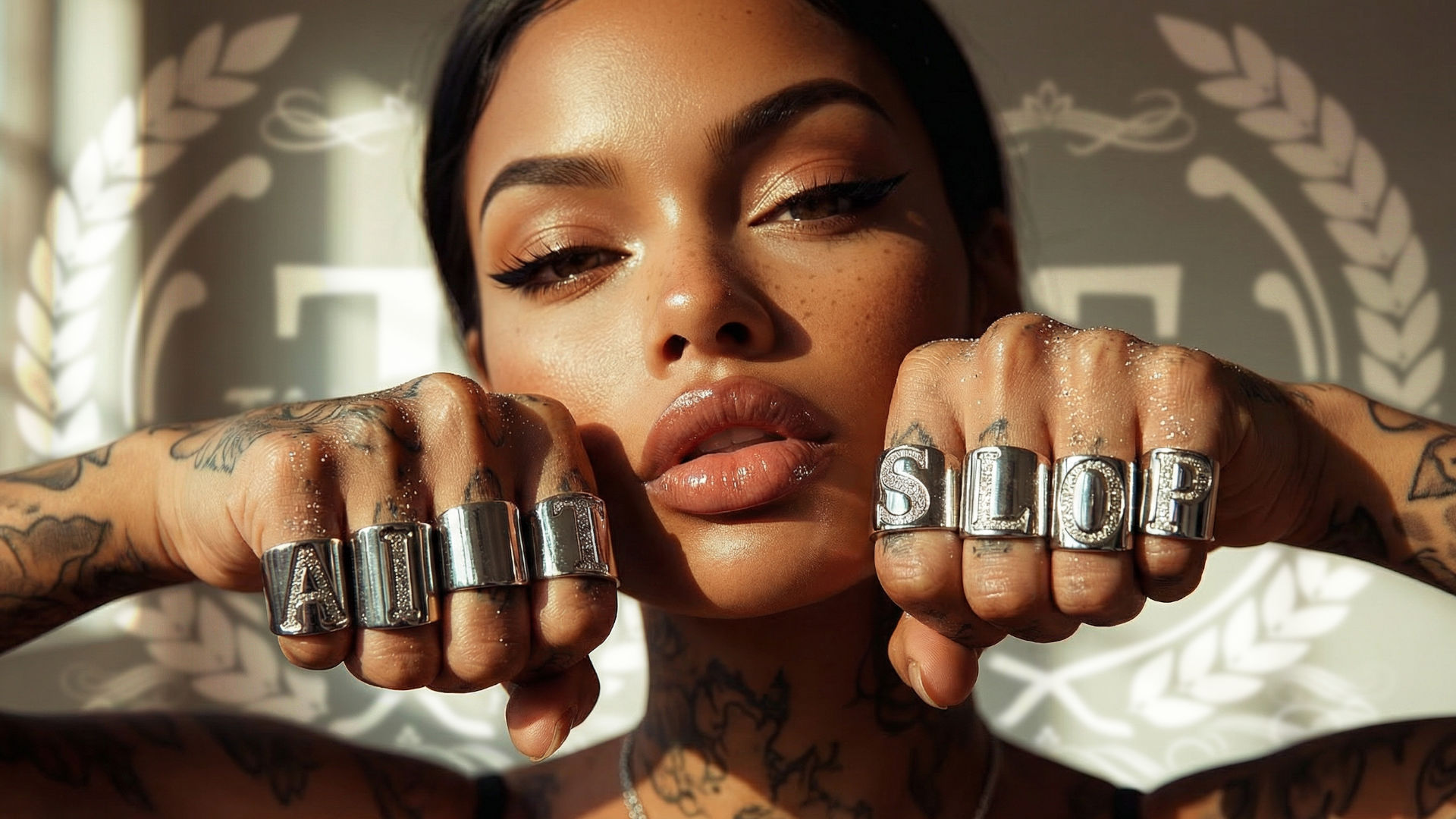
AI slop is flooding feeds and search in 2026, so here's how it breaks trust and how creators prove what's real without getting buried.
Why Everything Online Feels Fake In 2026 And What We Do Next
We need to talk about the vibe of the internet right now.
Not the "lol memes are back" vibe. The other one. The one where you scroll for five minutes and start feeling like you're trapped in a shopping mall where every store is staffed by mannequins, and every mannequin is trying to sell you something they've never touched.
That feeling has a name now: AI slop.
And it's not some niche tech insult anymore. Merriam-Webster literally crowned "slop" as its 2025 Word of the Year and defined it as low-quality digital content produced, usually in quantity, by AI. That's how mainstream this flood became.
This is our 2026 (Tanizzle: 4-Tech) kickoff for a reason. Because if Tanizzle wants to be an authority in tech culture, we can't just talk about what AI can do. We have to talk about what AI is currently doing to the texture of reality online.
And right now? It's clogging the pipes.
The Zombie Internet Isn't A Meme Anymore
People joke about the "dead internet," but the deeper fear underneath it is simple: what if most of what we see online isn't made by people anymore? What if it's bots talking to bots, content factories feeding platforms, and synthetic "engagement" bouncing around like an empty echo?
You don't need a conspiracy to feel the shift. You just need eyes.
The problem with slop isn't only that it's low quality. The real damage is that it makes the entire internet feel unreliable. When your timeline is full of suspicious images, recycled captions, fake "news," and suspiciously perfect product shots, you stop trusting the whole environment. Even the real stuff starts to feel fake by association.
And once trust collapses, everything online becomes harder: shopping, learning, relationships, even your own memory of what you saw.
Why AI Slop Hit Like Spam
Here's the clean comparison: spam didn't win because it was good. Spam won because it was cheap, scalable, and rewarded by distribution systems that didn't care about quality until the system started choking.
AI slop is the same playbook with prettier packaging.
Slop scales because it's fast, effortless, and built to exploit algorithms that reward volume. It doesn't need to be true; it needs to be clickable. It doesn't need to be useful; it needs to trigger something-outrage, curiosity, desire, disgust, envy. Anything that keeps you there.
So we get a feed that feels like a bargain bin of reality. And the worst part is that the bargain bin is slowly becoming the default store.
The "Can't Trust Your Eyes" Era
Even platform heads are saying the quiet part out loud. Instagram's Adam Mosseri has warned that we're entering a world where you can't assume what you're seeing is real anymore, and that we may need to shift from trusting imagery by default to being skeptical of it.
That's a wild sentence to be normal.
But it tracks. AI media isn't just "getting better." It's getting good enough to pass at speed. And speed is how most people consume content. Nobody is zooming in to audit the shadows. They're scrolling.
This is why slop is more dangerous than the early deepfake panic. Deepfakes were scary because they could target individuals. Slop is scary because it can target everything. It erodes the baseline.
Slop Isn't Just Ugly, It's Expensive
Let's talk consequences. Not vibes.
We're now seeing people get duped by AI-generated ads that show products that don't exist or look nothing like what arrives. The images are glossy, "professional," and emotionally persuasive. The actual item is, pain.
So slop doesn't just pollute culture. It pollutes commerce. And once people feel unsafe buying, they become cautious everywhere. That caution becomes friction. That friction becomes collapse in conversion. That's not just a creator problem; it's a whole internet problem.
The Internet Is Switching From "Detect Fake" To "Prove Real"
Here's the key pivot, and it's where Tanizzle gets surgical.
Trying to label every fake is a losing game. The fakes evolve too fast, the detection arms race never ends, and false positives are a mess. So the smarter shift is: stop chasing fake content and start proving authenticity.
Instead of asking "is this fake," we build systems that answer "this is real, here's why."
This idea has been explicitly discussed as a direction: fingerprinting authentic media so platforms can verify what's genuine at the source, rather than trying to spot every manipulation later.
And that leads to the most important concept of 2026: provenance.
Provenance Is The New Status Symbol
Provenance is the origin story of media-where it came from, what edits happened, what tools touched it.
This is exactly what C2PA (Coalition for Content Provenance and Authenticity) is pushing: an open technical standard that lets creators and publishers attach origin and edit information to content.
Then you've got Content Credentials-a user-facing way of showing that provenance exists (think of it like a "nutrition label" for media).
Important detail: this is opt-in. It's not magic. It's a framework. But it's the direction the internet has been begging for.
Because when everything can be generated, proof becomes premium, but it doesn't mean content creators should be compelled to use it - just saying.
Tanizzle's Take: The Authenticity Economy
This is where creators either level up or disappear into the sludge.
In the Authenticity Economy, attention doesn't go to the loudest anymore. It goes to the most recognisable. The most consistent. The most human. The most "oh yeah, that's them."
If your content can be confused with a template, you'll be buried by templates.
So what do we do?
We build a brand that feels like a person, not a content mill. We build patterns: voice, aesthetic, opinion, and receipts. We make it obvious that Tanizzle is not here to farm clicks; we're here to tell the truth in a way the internet can't easily counterfeit.
And yes, we use the system to our advantage too. Because search is becoming an answer engine. We already broke that down in our zero-click piece, and it connects directly: when content becomes sludge, platforms summarise it harder, and creators feel the squeeze. (Read: https://tanizzle.com/articles/416/whats-zero-click-and-why-google-answers-you-without-websites/).
How To Survive The Slop Flood Without Becoming Slop
We're not doing a fake "detox" sermon. We're doing strategy. First, you need to accept that volume is no longer the flex. Volume is what slop does. The flex is authority. Authority looks like consistency across topics. It looks like interlinking so readers (and bots) understand your map. It looks like answering real questions directly, then going deeper than everyone else. It looks like writing with a point of view. That's why this article exists next to:
Tanizzle Says: The Internet Didn't Die, It Got Counterfeited
We're living in the era where "looking real" is cheap and "being real" is the premium product.
AI slop isn't scary because it's cringe, it's scary because it makes trust feel optional, and once trust becomes optional, everything becomes a hustle.
So we build Tanizzle like a signal in the noise - consistent voice, consistent receipts, consistent perspective - until the algorithm learns our name and people stop scrolling past us like we're just another template.
From Us, For You: AI slop is not just about ugly visuals. It is also about the culture around synthetic content, where cheap novelty can sometimes be easier to reward than deliberate creative work. That tension showed up clearly in our explainer on r/aivideo, Reddit AI video culture, and AI video gatekeeping.
Tanizzle FAQs: The End of AI Slop?
What Is AI Slop?
AI slop is low-quality digital content produced in high volume using AI, and the term became mainstream enough that Merriam-Webster named "slop" its 2025 Word of the Year.
Why Is AI Slop Everywhere In 2026?
Because it's cheap to generate, easy to mass-post, and algorithms still reward engagement and volume, even when quality collapses.
Is The "Dead Internet Theory" Real Or Just A Meme?
It's a meme with a real anxiety behind it: the sense that bots and synthetic content are drowning out human creation, making the web feel less trustworthy and less alive.
How Can You Tell If An Image Is AI-Generated?
Sometimes you can spot artifacts, but the harder truth is that "visual inspection" is becoming unreliable, which is why provenance systems are gaining attention.
What Are Content Credentials And C2PA?
C2PA is an open standard for content provenance, designed to attach verifiable origin and edit history to media, and Content Credentials is the broader ecosystem and user-facing signal for that provenance.
Why Are Platforms Shifting From Detecting Fakes To Proving Real Content?
Because detecting every fake becomes an endless arms race, while proving authenticity at capture and through cryptographic provenance can scale trust more reliably.
Does AI Slop Affect Google Search And SEO?
Yes, because as low-quality content floods the web, search engines lean harder into summaries and answer layers, which can reduce clicks and make authority signals more important.
How Do Creators Prove Their Content Is Real?
By building recognisable brand patterns, publishing consistently, using interlinks and receipts, and adopting provenance tools as they become more widely supported across platforms.