
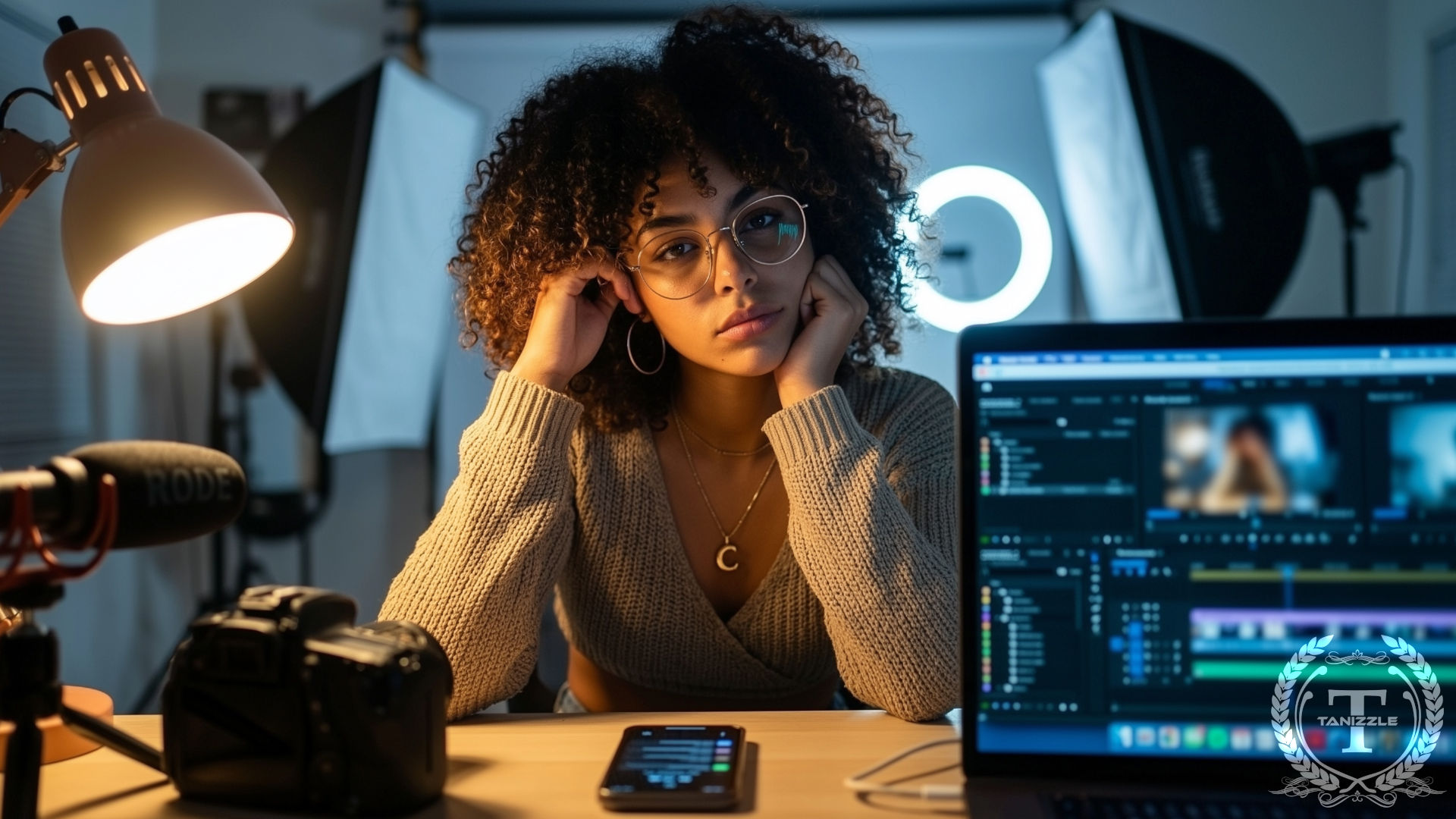
Being a content creator looks like a dream from the outside, but behind the views and brand deals there's burnout - and a constant fear of becoming irrelevant. Tanizzle breaks down why so many creators secretly want to quit and why they don't.
You Love Creating - So Why Does It Feel Like It's Killing You?
There's a specific kind of late-night thought only creators understand.
You close your laptop, or finally put your phone down after editing, posting, replying, checking, refreshing, checking again, pretending not to care, then checking one more time. The video didn't hit the way you hoped. The post did "okay, not great." The brand you were praying would notice you didn't. Your notifications are noisy, but your bank account isn't.
And in that quiet, brutal moment, a thought appears: "What if I just deleted everything?"
Not a rebrand. Not a break. A full purge. No more algorithm anxiety. No more constantly selling yourself. No more wondering if you're one trend away from being irrelevant. Just a normal job, a private life, and the ability to exist without mentally calculating "Would this make good content?" every time something happens.
If you've ever fantasised about nuking your entire online existence, you're not alone. Recent research on the creator economy keeps saying what creators already feel in their bones: more than half of creators report burnout as a direct result of their work, and nearly two in five have seriously considered leaving the industry altogether. A newer study found that around sixty-two percent of creators report burnout, roughly sixty-nine percent experience financial instability, and about one in ten admit to suicidal thoughts tied to their work.
So no, you're not dramatic. You're not ungrateful. You're not weak. You're a human being trying to be an entire media company (sounds like Tanizzle), public figure, therapist, accountant and product, all inside one nervous system. Of course a part of you wants to quit. The real question is why you don't - and whether there's a version of this life that doesn't require burning yourself down to stay visible.
On Tanizzle, we've already talked about what happens when tech rearranges your sense of self in "Why People Don't Feel Like Themselves Anymore" and how your reward system gets farmed in "Why Does Your Brain Love Dopamine Fixes So Much?" This piece plugs that same reality into the creator economy. Because if anyone is living inside the algorithm more than the average user, it's you.
The Dream Job That Became A New Kind Of Grind
Content creation was sold as the escape hatch. No office. No boss. No dress code. Just you, your ideas, your camera and the internet. You'd work for yourself, build an audience, and finally stop trading your time for someone else's dream.
The highlight reel still looks like that. From the outside, creators are living soft life: free PR packages, press trips, flexible hours, passive income while they sleep. That image is powerful, which is exactly why so many people feel guilty for struggling. How can you be burned out when other people are working two jobs just to pay rent?
But the reality inside the role looks different. Most creators work far beyond a "normal" workday, often seven days a week, constantly switching between filming, writing, editing, scripting, replying, planning, pitching and negotiating. There's no HR, no sick pay, no manager shielding you from chaos, no clean line where the workday ends and your personal life begins. Studies on the creative and media industries have shown burnout rates hovering around seventy percent, even outside influencer culture. When you layer social media visibility on top of that, the stress multiplies.
What makes it worse is the gaslighting. You're told you're "lucky" to do what you do, so you start to believe you've lost the right to feel overwhelmed. You swallow the resentment; you overcompensate with more content; you call exhaustion "the grind." But the body keeps count, and at some point, the same job that once felt like freedom starts to feel like a cage with ring lights.
You Can't Pause The Internet - And That's The Problem
A normal job, in theory, has moments where things shut down. Shops close. Offices lock. Even if you're underpaid and overstressed, there is at least a concept of "off."
Creators don't get that. The feed does not pause. The audience does not log out. The algorithm does not send you a message saying, "Take a break, babe, we'll keep your spot warm." In practice, creators are working inside an environment where the workday never ends - only their capacity does.
Several recent surveys and articles have started calling this out. One widely reported study of a thousand creators in the US and UK found that fifty-two percent have experienced burnout as a direct result of their career, and thirty-seven percent have considered quitting altogether. Others describe creators talking about feeling like they can never fully rest because stepping away means losing momentum, reach and revenue.
That's the brutal irony: the more burned out you feel, the more dangerous rest feels. Because in this game, a break doesn't just cost energy. It can cost visibility, brand opportunities, and a chunk of whatever income you've managed to stabilise. That's not "just in your head." The system genuinely punishes slowness.
So you stay online when you actually need to log off. You say yes to campaigns you don't like. You keep feeding the machine because the machine doesn't know how to live without you, and you don't know how to live without it. Bro, the machine is real.
Algorithm Anxiety: When Your Metrics Become Your Mood
If you've ever opened your app and felt your heart drop before you even looked at the comments, you've met algorithm anxiety. It's that background hum of dread that lives behind every upload. Did the video get pushed? Did notifications go out? Did you lose favour because you skipped a trend or posted at the "wrong" time?
The problem isn't just that creators care about numbers. It's that those numbers are opaque. The recommendation systems deciding whether you're visible or invisible are black boxes, constantly shifting and optimised for whatever maximises engagement overall - not for your long-term stability or mental health. Research into social media algorithms has started to highlight how engagement-driven feeds amplify extreme emotions, push anxiety-inducing content and reinforce unhealthy behaviour because intense reactions keep people online. Creators sit directly in the blast zone of that logic.
Over time, creators start merging self-worth with performance. A bad week of views doesn't feel like "the content didn't land." It feels like "I am getting worse." A slow month feels like a personal failure, not a natural fluctuation. When every post is tied to your persona, your life, your body, your relationship or your opinions, there's no difference between "they didn't like the video" and "they don't like me."
Layer on the stuff we already broke down in our dopamine article - the way your brain gets trained to seek fast, measurable hits - and you're in a perfect storm. You become both the addict and the dealer, wired to chase numbers that secretly exhaust you.
Money, Instability and The Fear of Becoming "Old News"
Let's talk about the part most creators only admit in private: the money side.
The creator economy is loud about wins. Brand deals. Sponsorships. "I made six figures in my sleep." But when studies actually ask creators how they're doing, a different story shows up. A 2025 mental health report on digital content creators found nearly seventy percent experiencing financial instability, with over sixty percent also reporting burnout. Another study highlighted financial uncertainty and delayed payments as top stressors, with many creators feeling underpaid and constantly anxious about the next check.
When your income depends on brand moods, algorithm moods and audience moods, you live in permanent "maybe." Maybe this month is great. Maybe it's dead. Maybe your niche suddenly pops. Maybe the platform quietly changes something and you're invisible for six months. That volatility does not sit well with human nervous systems.
Add ageing into the mix, or just time. The internet loves fresh. Creators know it. There's always a younger face, a louder voice, a trend-native baby influencer who understands the new platform better than you. Even if you're objectively fine, there's a constant background fear of becoming old news.
Put that together: unstable income, no safety net, no clear career ladder, an audience that can leave at any time and a platform that can turn you down without warning. Of course part of you wants to quit. Of course you feel trapped. You're being asked to constantly prove your value in an environment where the rules change faster than human beings can adapt.
Why You Haven't Quit (Even Though You Think About It)
So with all of that, why are you still here?
Because you do genuinely love creating. You love that you can turn ideas into things people see. You love the messages where someone says your video helped them, made them laugh on a bad day, taught them something that actually made their life easier. You've built friendships, communities, in-jokes, little pockets of the internet that feel like home. Walking away would mean giving that up.
You also have an identity now. You're not just your legal name or your old job title. You're "the person who makes X." You're the girl with the chaotic storytimes, the guy with the clean tutorials, the voice that explains complex topics simply, the gamer who streams every night. That identity is both armour and pressure. If you quit, who are you then?
And then there's sunk cost. You've spent years learning platforms, editing, storytelling, building trust. You've already been through the humiliation of starting from zero once. The idea of burning it all down to go sit in a cubicle or stack boxes or deal with emails in someone else's CRM feels like emotional death. So you stay. You fantasise about quitting, and then you go back to planning the next upload.
In other words: you haven't quit because there is something real here. This isn't just vanity. It's a craft. It's a path. It just happens to be wrapped in a system that treats your mental health as a disposable expense.
From Burnout Trap To Builder Mode
Here's the part nobody wants to say out loud: the creator industry, as currently structured, is not designed for your wellbeing. It's designed for retention, growth and volatility. If you try to play that game on "max effort, no boundaries," you will lose. Your body will tap out before the algorithm does.
The answer isn't "just leave" and it isn't "grind harder." It's to stop playing as a grateful employee of the algorithm and start playing as a builder with your own rules. On Tanizzle we already went practical with "The Ultimate Guide To Prevent Burnout For Content Creators" - that's where we talk systems, routines and guardrails. This article is the emotional permission slip behind it.
At some point, every serious creator has to decide what game they're actually playing. Are you trying to be the algorithm's favourite child forever, or are you trying to build a life? Those two goals are not always the same. Sometimes they're directly opposed.
A sustainable version of this work looks boring on the surface. It means being okay with views dipping while you rest. It means planning content like a professional, not panic-posting like a hostage. It means diversifying income so one app doesn't hold your entire self-worth and rent money. It means accepting that you are allowed to be a person first and a brand second.
None of that will be handed to you by the platforms. They need your output, not your stability. You'll have to design that stability yourself. The good news is, the same creativity you use to make content is the same muscle you need to design a better container for your life.
Tanizzle Says: The Dream Job Still Needs A Safety Net
Being a content creator was never a stupid choice. The stupid thing was pretending that turning your life into content 24/7 was going to feel like freedom forever. It's okay if the job you love is also the job that's burning you out. Both can be true at the same time.
Wanting to quit doesn't always mean you hate creating. Sometimes it just means you hate the way you've been forced to create: rushed, sleep-deprived, under constant scrutiny and with zero structural support. You are not weak for wanting out of that. You're awake.
The real power move isn't to disappear in silence and call the whole experiment a failure. The power move is to renegotiate the deal. That might mean fewer uploads and better ones. It might mean shifting your content, shifting your income streams, or shifting how much of yourself you are willing to sacrifice for reach. It definitely means building systems that make you feel like a human, not a content hose.
The creator industry will not build that safety net for you. It never had to, because there's always another hungry person willing to burn themselves out for a shot. You're going to have to build it for yourself. And you're allowed to.
Because the goal was never just to be seen. The goal was to create a life where the person behind the camera also gets to survive the story.
Tanizzle Creator FAQ - The Questions You're Too Tired To Google
Is it normal to feel like I want to quit content creation?
Yes. You're not the only one. Surveys of creators in the US and UK have found that more than half report burnout as a direct result of their work, and around a third have actively considered leaving the industry. Newer mental health research on digital creators shows similarly high levels of stress, anxiety and exhaustion. Feeling done doesn't mean you're ungrateful; it means the way your work is structured is genuinely heavy.
How do I know if I'm burned out as a creator and not just tired?
Burnout tends to go beyond ordinary tiredness. You might notice that making content you used to enjoy now feels numb and joyless. You dread opening your apps, but you feel compelled to check them anyway. Your sleep is wrecked, your boundaries between "work" and "life" have basically dissolved, and your mood follows your analytics. You might find it hard to care about things that used to matter, or you feel permanently on edge and emotionally flat at the same time. Many creators also describe a sense of cynicism and detachment from their own audience, as if they're performing to a room they're not really in anymore.
Do I have to quit completely to feel better?
Not always. Some creators walk away and never look back. Others step back, reduce their output, restructure their content, change platforms, or rebuild their schedule and boundaries. There isn't one "correct" path. What the research keeps repeating is that trying to grind through severe burnout with no changes tends to make things worse, not better. A more realistic move is to redesign how you create so that your nervous system gets a say, not just the algorithm. That might mean less content, different content, or content that serves a bigger strategy instead of just feeding the feed.
Where do I start if I want to stay a creator but stop feeling destroyed?
Start by admitting that "more" is not the answer. Then start small. Give yourself permission to rest without calling it failure. Build even one tiny system that protects you, whether that's a fixed upload schedule, a non-negotiable day off, or a separate savings plan that isn't dependent on one app. If you need a practical blueprint, go back to Tanizzle's "The Ultimate Guide To Prevent Burnout For Content Creators" and treat it less like homework and more like survival protocol. You're allowed to build a version of this career that doesn't require you to lose yourself in the process.