Tanizzle Official Logo, and Branding
--- advertisement scroll below ---
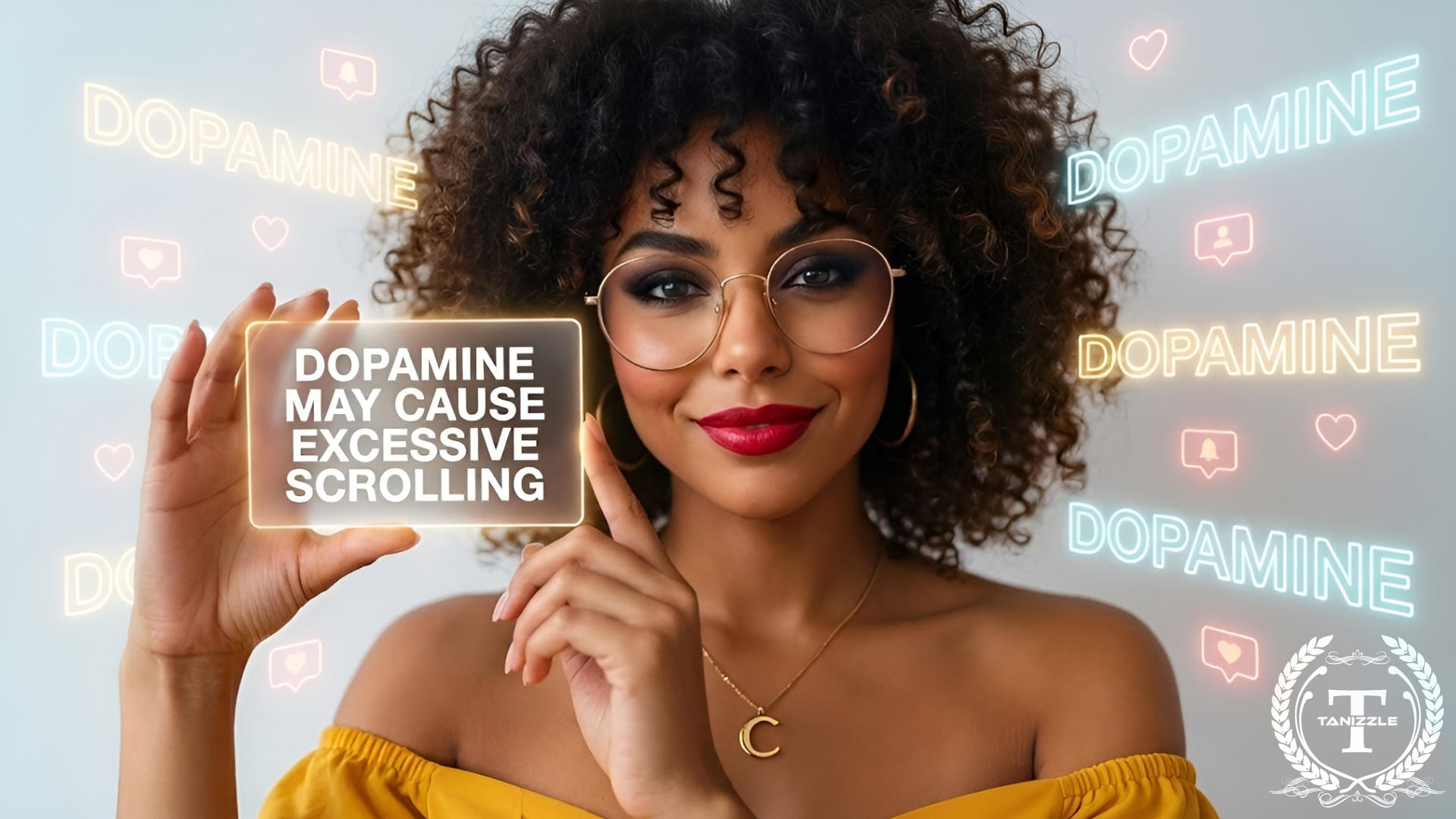
What is dopamine? Why Your Brain Loves Dopamine (Model: Clara Mirage)
What is dopamine? Why Your Brain Loves Dopamine (Model: Clara Mirage) - Courtesy: Tanizzle Design
--- advertisement ---

Your brain isn't addicted to your phone by accident. Dopamine, your brain's reward signal, is wired to chase instant hits - and modern apps, feeds and notifications are built to exploit it.

Your Brain Isn't Broken - It's Just Addicted To Rewards

You know that moment when you close an app and realise you don't even remember half of what you just scrolled through? You open your phone to check one notification, and suddenly half an hour has disappeared into a blur of memes, drama, random life updates and a dog video that absolutely did not need a sequel. You put the phone down feeling foggy, slightly wired and weirdly annoyed at yourself. The default diagnosis is always the same: "My attention span is ruined. My brain is broken. I have no self-control."

The truth is less depressing and more dangerous. Your brain is not broken. Your brain is doing exactly what it evolved to do: chase rewards. The problem is that in 2025, your environment has upgraded and your reward system is still using ancient firmware. You are carrying a device designed to hand out endless tiny dopamine hits customised to your identity, your mood and your boredom level. So no, your brain doesn't hate you. It just really loves dopamine — far more than you think.

Here's some Tanizzle food 4-Thought.

advertisement - scroll below

Dopamine Isn't Just "Pleasure" - It's The Chase

Online, dopamine gets reduced to a cute headline: the "pleasure chemical." It sounds sweet, simple and totally wrong. Dopamine is less about pleasure itself and more about importance, anticipation and pursuit. It spikes when your brain predicts that something will be rewarding, when it decides a cue or a behaviour is worth remembering, when it wants to nudge you towards action.

You feel that little lift when you see "1 new notification" before you even open it. There is a tiny spark when the feed refreshes, even if what loads is mediocre. When you look at your lock screen and notice three new icons, your body reacts before your brain has time to think. Dopamine is behind that reaction. It's like your internal project manager saying, "Pay attention. This might matter."

Crucially, it doesn't just fire when you get the reward. It fires around the expectation of the reward and the learning that comes from it. When something repeatedly feels good, dopamine quietly writes a note in your internal rulebook: "This works. Do it again." In a world with limited food, danger and a small group of people you actually know, this is a practical system. In a world with infinite content, infinite strangers and infinite refresh buttons, that same system gets absolutely rinsed.

How Your Phone Turned Into A Portable Dopamine Farm

We like to pretend our phones are neutral tools, just modern communication devices replacing letters and landlines. That's cute. Very cute. But your phone is a personalised dopamine farm, and every major platform is optimised to grow and harvest your attention.

Every tap, swipe and pause is being measured and fed back into a model that is trying to answer one question: "What will keep this tech-zombie here a little longer?" Pull-to-refresh is not an innocent design choice. It is a miniature slot machine mechanic: maybe something new appears, maybe it doesn't, try again. Infinite scroll is not a convenient layout. It is an environment with no natural stopping point, no closing page, no "you're done now" signal for your brain. Notifications are not neutral reminders. They are tiny surprise boxes, each one carrying the possibility of social approval, drama, validation, opportunity or panic.

Dopamine doesn't care if the content is positive or negative. It cares about intensity and relevance. Outrage, fear and jealousy can be just as rewarding to the brain as cute animals and wholesome posts, because they all scream "this is the dope." Your brain tags high-intensity content as worth noticing. Platforms convert that tagging into metrics. You experience it as "I can't stop preeing my phone." The system experiences it as "session length is up."

advertisement - scroll below

You're Not Lazy - Your Reward System Got Recalibrated

One of the most frustrating side effects of this dopamine environment is the way it quietly drains your motivation for anything that isn't instant. You might notice a pattern in your own life: you can scroll for an hour without breaking a sweat, but starting a task that genuinely matters feels like lifting a car. It's not that your values disappeared. It's that your reward system has been trained to expect fast feedback and constant novelty.

Important work rarely behaves that way. Learning a skill, building a business, working on your health, fixing your finances or even maintaining close relationships all move slowly. They demand effort, they generate friction, and the payoff lands weeks or months later. If your brain has been conditioned to expect a steady stream of tiny rewards every few seconds, of course it resists activities where the reward is delayed, uncertain or invisible at the beginning. It's like living on ultra-sweet processed food and then switching back to fruit. The fruit isn't broken. Your taste has been shifted.

So when you sit down to do something that matters and your whole body screams "this is dead, this is hard, let's check something else," that isn't proof that you are weak. It's proof that your defaults have been hijacked. Your brain is doing what it learned. It's choosing the easiest available hit instead of the most meaningful one - like watching Tanizzle Studios on YouTube (or maybe not!).

The Dopamine Detox Fantasy

The dopamine detox fantasy (Model: Clara Mirage)
The dopamine detox fantasy (Model: Clara Mirage) - Courtesy: Tanizzle Design

When people realise how deep this goes, they look for a hard reset. That's where the idea of a "dopamine detox" exploded. The promise is seductive: shut off all fun, avoid screens, suffer through a day or two of boredom, and your brain magically resets to factory settings. Overnight discipline. Clean slate. Monastic focus.

Biology does not work that neatly. You cannot detox from dopamine in the way you detox from a substance. Dopamine is a core part of movement, decision making, learning and motivation. You are not trying to flush it out of your system. You would not last very long if you did. The language is wrong, but the instinct underneath has a point. If you overstimulate your reward system constantly, your sense of what counts as "normal" shifts. Silence feels threatening. Slowness feels painful. Any activity that doesn't scream for your attention feels empty.

When people take a break from ultra-stimulating behaviour, something does change - not because they purified their brain chemistry, but because they broke a few loops. They stopped feeding the endless cycle of micro-rewards. They gave their nervous system time to realise that it can survive without constant hits. That is not a miracle cure. It doesn't erase habits or trauma or long-term patterns. But it does prove one crucial thing: your brain is plastic. The same system that got trained to chase cheap rewards can be retrained to care about better ones.

Upgrading Your Dopamine Diet

If dopamine is how your brain learns what to chase, then the goal isn't to kill it. The goal is to curate it. Think of your dopamine input like a diet. Right now, most people are living on emotional junk food: endlessly snackable, instantly gratifying, nutritionally empty. A scroll here, a notification there, a video autoplaying into the next one. It all feels like "nothing," but it adds up to a constant low-grade drip that leaves you numb and overstimulated at the same time.

Upgrading your dopamine diet doesn't require you to disappear into a monastery. It means deliberately lowering the volume on the cheapest hits and deliberately feeding your brain more substantial ones. That might look like turning off non-essential notifications so your phone doesn't yank you around all day. It might mean checking social apps at set times instead of letting them bleed into every gap. It definitely means reintroducing activities that feel slow and awkward at first: long walks with no audio playing, workouts that are uncomfortable before they're satisfying, hobbies where you're bad at the start, deep work blocks where your attention has time to stretch out again.

At first, none of it feels like a reward. Your brain sulks because it misses the fast stuff. Then something shifts. Completing a difficult task starts to release its own satisfaction. Seeing progress on a project becomes genuinely enjoyable. Being fully present in a conversation feels richer than reacting to five conversations at once online. The dopamine is still there. It's just being redirected towards things that actually move your life, instead of things that simply fill your time.

advertisement - scroll below

Using Tech To Help Your Brain, Not Hijack It

Tanizzle isn't here to preach digital exile. We are not anti-tech and we are not anti-dopamine. We are anti-autopilot. Technology is not going away. Feeds are not going to suddenly become gentle and wholesome just because you discovered neuroscience. AI is not going to un-invent itself and apologise. The only realistic option is to use the system deliberately.

That starts with basic environment design. If your phone is always within reach, always lit up, always full of icons demanding attention, you are fighting a battle you will lose. If your apps are the first thing you see when you unlock, they will win. Small changes matter: moving addictive apps off the first screen, charging your phone outside the bedroom, giving yourself one or two intentional scroll windows instead of scrolling as a reflex whenever life pauses for five seconds. The aim isn't to prove you're strong. The aim is to stop constantly testing yourself for no reason.

The other side is using tech to amplify the parts of your life that deserve dopamine. AI can help you plan, learn, script, write, edit and track progress in ways that make big goals feel less overwhelming. Tools can remove friction from studying, creating, building businesses or managing your day. When you use your devices to support meaningful rewards, you train your brain to expect dopamine from what actually matters. The same system that once learned, "We scroll to feel alive," can learn, "We build things, we move, we connect, we focus."

Tanizzle Says: Your Brain Isn't The Enemy - Your Defaults Are

Your brain loves dopamine. That love is the reason humans made it this far. Without that reward system, nobody would have bothered to hunt, build, learn, flirt, create or survive long enough for you to be here. The difference now is that the world around you has upgraded faster than your wiring. Your brain evolved to chase a few meaningful rewards a day. Your phone can deliver hundreds of artificial ones before lunch.

If you let your default settings run the show, you will absolutely feel addicted, scattered and numb. Not because you're weak, but because your environment is engineered to keep your reward system on a leash. You don't need to declare war on your own biology or pretend you hate every app you secretly enjoy. You just need to stop giving the cheapest, loudest signals first-class access to your nervous system.

Learn how your brain responds. Notice what you chase without thinking. Start feeding it richer things to want. Use technology to deepen your life instead of flattening it. The dopamine isn't going anywhere. The question is who gets to decide what earns it.

Because if you don't decide what feels rewarding, an algorithm will. And it won't pick what's good for you. It'll pick what's good for retention.

--- advertisement ---
Independent journalism could use your help
Support Tanizzle: Click to reveal Bitcoin address
--- continue scrolling ---
Visit the Tanizzle Homepage
Visit the Tanizzle homepage and get the latest of Splocus Ai, Tanizzle BAE, articles, videos, products, and promotions.
Why not like, share & comment?
--- advertisement ---
Recommendations
More articles
--- advertisement ---
More Content? Click Here
Loading Content...
Tanizzle Q&As
--- advertisement ---
Tanizzle On YouTube
We You!
Click here to visit the Tanizzle homepage and get an update of the latest articles, videos, products, promotions and Tanizzle BAE (models).
I Dare You To Click This... Again!
--- advertisement ---
Want Freebies?
Promo Alert!
Click for more: Second brain gear that helps you capture ideas fast, organise notes cleanly, and back up your digital life without turning productivity into a second full-time job.
Did Somebody Say Gift Cards?
--- advertisement ---
Amazon is a click away!
T A N I Z Z L E
S T O R E
disabled
control centre
hello!
your privacy matters
take control of your data
Official Tanizzle Branding (Logo)

Tanizzle and our partners use cookies and similar tracking technologies, as well as artificial intelligence (AI) systems, to: deliver content and ads tailored to your interests, allow you to interact with social media platforms directly on Tanizzle; analyse website traffic and usage patterns, and provide personalised recommendations and features powered by AI. These technologies may collect and process personal information (your "Gold") to understand your preferences and provide a better user experience. By clicking "I Accept," you consent to the use of cookies, AI technologies, and the processing of your Gold as described in our Terms of Service, Privacy Policy, and AI Policy.

dismiss

Tanizzle Control in Locked Mode

After expanding a tab and deciding to toggle on, or off any first or Third-Party preference, engage the Save button to implement changes after scrolling below. By dismissing this message without making changes, you confirm that you have read and agree to the Tanizzle Terms of Service, Privacy Policy, and AI Policy

tanizzle preferences

Tanizzle utilises storage technologies, including HTTP Cookies and HTML5 Storage, to ensure essential website functionality. Disabling these technologies may impact the website's performance and can only be accomplished by adjusting your browser settings. Certain necessary storage options are mandated for security and to retain your preferences during your visit. Explore our complete list of essential cookies.

Our personalisation and enhancement cookies offer convenient features that remember your preferences, whether temporarily or permanently. These cookies neither personalise ads nor share information with Third-Party companies unless you grant permission. To ensure the best user experience, we recommend keeping these cookies active.

Analytical cookies play a crucial role in our continuous improvement efforts by collecting and reporting information on how our site is used. Rest assured, these cookies are not shared with any Third-Party companies, and they do not identify users without their consent. They help us distinguish between new and returning users. While the cookie name may change in the future, it is currently identified as "TACT_IX.".

social media plugins aka widgets

We employ Third-Party social media plugins, also referred to as widgets, to facilitate convenient actions like content sharing, video viewing, account creation or login, and site searches. These plugins may employ cookies or similar storage technologies on your device to enhance account security, combat fraud and abuse, conduct analytics, and other functions beyond Tanizzle's control.

Google search is a custom tool provided by Google that allows developers to take advantage of it's powerful search capabilities, and revenue benefits by serving both non personalised, and personalised ads within search results. Google will always prioritise, and display Tanizzle related search results if found. Google uses cookies, and monitors all searches. Learn more about the cookies used by Google.

YouTube is a video broadcasting, and sharing service owned by Google. Tanizzle embeds YouTube videos, and uses their API tools. In order to view YouTube videos, you must enable this preference with the understanding that cookies will be set by a Third-Party. Learn more about the cookies used by Google.

Facebook SDK gives you the ability to share content, write and view comments; like and save content, watch videos, and chat with us using Facebook Messenger. Facebook uses cookies when the SDK's enabled. Learn more about Facebook Privacy and Cookies.

Instagram SDK for widgets gives you the ability to view, and share Instagram posts, moments, videos and more. Instagram's a Meta owned company, and uses cookies when the SDK's enabled. Learn more about Instagram Cookies.

X (formerly Twitter) SDK gives you the ability to share content quickly, like, and post, as well as interact with other X widgets. X uses cookies when the SDK's enabled. Learn more about X (Twitter) Cookies.

advertising platforms

Advertising plays a vital role in keeping Tanizzle free and supporting the development of new services. While disabling ads won't eliminate Third-Party ads, it will remove personalised ads. Our advertising partners automatically receive your IP address and process your data when ads are displayed. They utilise cookies for tasks like frequency capping, aggregated ad reporting, and combating fraud and abuse. Additionally, technologies such as JavaScript or Web Beacons may be employed to gauge ad effectiveness, personalise content, and verify ad delivery. Discover more about your ad preferences.

Yllix (Performance Ads)
ExoClick (Personalised Ads)
InfoLinks (Personalised Ads)
Avantis Video (Personalised Ads)
Propeller Ads (Personalised Ads)
Yandex (Personalised Ads)
Media.Net (Personalised Ads)
Google AdManager (Personalised Ads)
Google AdSense (Personalised Ads)
eBay Partners (Personalised Ads)
Amazon Associates (Personalised Ads)
Performance analytics

Performance and analytical cookies drive the Tanizzle engine. We use cookies and beacons to track site usage and understand how you navigate our content. This data is crucial for building new features and ensuring a smooth user experience. We also leverage these insights for security, fraud prevention, and to ensure the advertising you see is actually relevant. To see who we partner with, check our Privacy Policy.

Ezoic is an award-winning end-to-end platform for digital publishers and website owners that helps them improve revenue, traffic, SEO, website speed, infrastructure, regulatory compliance, and more.

Microsoft Clarity and Advertising is a behavioral analysis tool and advertising platform that helps us understand how users interact with Tanizzle through metrics, heatmaps, and session replays. The tool captures visual data on user engagement, allowing Tanizzle to identify bugs, improve website layout, and optimise the security and relevance of the advertising displayed.

Google Tag Manager is a tag management system created by Google to manage JavaScript and HTML tags used for tracking, and analytics on websites. The tool allows developers to manage several Third-Party tags in one place without touching site source code. Given the simplicity of the tool Tanizzle can quickly add, or remove options at a later date.

While Tanizzle respects users' choices regarding cookies, please note that some previously set cookies on your device may persist until manually removed. Rest assured, Tanizzle will not activate features prohibited by your preferences during any subsequent visits to our pages. These actions will only occur after you engage with methods that explicitly allow the saving of preferences in the Tanizzle Control Centre, such as the Save button.
reset
check all
Save
Contact

If you have general questions, legal requests, special marketing or advertising inquiries, or feedback, please utilise the Tanizzle Contact form - if it's enabled. Please note that while Tanizzle will make an effort to respond to messages, in most cases, users will receive an automated response - meaning, there's a chance we won't holla back!

Personal data

By sharing your personal information (referred to as "your Gold") with Tanizzle, you acknowledge that you have read and agreed to our Terms of Service, Privacy Policy, and AI Policy.

control centre
close
Accounts

At Tanizzle, we firmly believe in putting you in control of your personal information (referred to as "your Gold"). We are committed to ensuring that you understand why and how your data is being utilised. For detailed insights into the information collected when creating accounts or subscribing to our services, please refer to our Privacy Policy. We encourage you to explore it to make informed choices about your data.

registering accounts

Creating a Tanizzle Account: When you create a Tanizzle account, we will collect certain information. This includes your first name and email address, which are essential for communication, as well as your password to ensure account security and integrity.

We also request your gender and location, although providing this information is optional. You can choose "Prefer not to say" or select from the other menu options. It is mandatory to provide your date of birth for content restrictions and to comply with relevant age-related laws.

To understand why Tanizzle does not allow accounts for children under the age of 13, please refer to our policies.

login signing in

Signing into Tanizzle: To sign into Tanizzle, you will need to provide a Tanizzle Username or an email address, in addition to a password.

Important: If you forget your password and no longer have access to the email address linked to your account, please note that account recovery may not be possible unless you have previously set a Tanizzle Username.

control centre
close
Splocus Ai::Speak
Splocus Ai audio

Customise your Splocus Ai experience with these audio settings, including voice and sound effects (collectively, "Splocus Ai::Audio"). Use the convenient mute options to control the volume of Splocus Ai's output. To ensure a seamless experience, cookies are used to store your audio preferences. Reset Tanizzle Control to clear these settings quickly. You acknowledge and agree that by using Splocus, you accept the terms outlined in the Tanizzle AI Policy.

Splocus Ai Mute: Deactivate this setting to completely silence Splocus Ai::Audio (voice and sound effects).

Splocus Ai Mute SFX: Deactivate this setting to mute Splocus Ai sound effects.

Splocus Ai Mute Voice: Deactivate this setting to mute Splocus Ai's voice.

While Tanizzle respects users' choices regarding cookies, please note that some previously set cookies on your device may persist until manually removed. Rest assured, Tanizzle will not activate features prohibited by your preferences during any subsequent visits to our pages. These actions will only occur after you engage with methods that explicitly allow the saving of preferences in the Tanizzle Control Centre, such as the Save button.
control centre
Save
Splocus Ai::Settings
Splocus Ai::Speak

Splocus Ai::Speak (or simply "Splocus") is a digital assistant designed to help users effortlessly navigate Tanizzle Assets. Splocus (pronounced "Splo-kus") also serves as a speech detection feature, enabling hands-free navigation and interaction with Tanizzle AI. By enabling Splocus, you grant Tanizzle access to your microphone for continuous listening and detection until disabled. You acknowledge and agree that by using Splocus, you accept the terms outlined in the Tanizzle AI Policy.

Navigating to Sections:

  • Want to read some articles? Say "Splocus, go to articles."
  • Looking for something to buy? Say "Splocus, take me to products."
  • Interested in some gorgeous baddies? Say "Splocus, show me models."
  • Got a few questions and need answers? Ask "Splocus, show me questions."
  • Want to tweak your personal data or user settings? Say "Splocus, open Friend Hub."
  • Feeling visual? Try "Splocus, show me videos" (or "Splocus, load studios" for Tanizzle on YouTube).

And then some:

  • Curious about Tanizzle? Say "Splocus, explain Tanizzle."
  • Want legal info? Ask "Splocus, show me legal pages."
  • Want to adjust Tanizzle Settings? Ask "Splocus, open Control."
  • Trouble saying Splocus (it's pronounced "Splo-kus")? Click here to hear Splocus pronounced.
control centre
Enable Splocus Ai::Speak
Try Amazon Prime 30-Day Free Trial